
If you heat your home with oil or gas, the same bill comes round every winter: a tank to fill or a gas invoice to pay. Replacing the boiler with a heat pump cuts that cost to a fraction, and before deciding it is worth knowing by how much, what work it involves and what it costs. Here it is, worked out from the technical data of the units we install and from real fuel prices. If you would rather start from your own figure, the heat pump price calculator gives it in a minute.
Is it worth replacing an oil or gas boiler with a heat pump?
To find out, compare the kWh of heat, not the price of the fuel. Heating oil is sold by the litre, LPG by the kilo, and gas and electricity by the kWh, and no appliance turns all the energy it uses into heat inside your home. The fair comparison is what one kWh of useful heat costs once each appliance’s efficiency is applied.
A combustion boiler uses about 85% of the energy in its fuel. A heat pump works the other way round: it draws heat from the outside air and, for every kWh of electricity it uses, delivers between 3.8 and 6.9 depending on the temperature it works at. That ratio, measured over a whole season, is the SCOP.
| Heat source | Price | Cost per kWh of heat | Saving vs heating oil |
|---|---|---|---|
| Heating oil | €1.532/litre | €0.18 | Reference |
| LPG (propane) | €1.70/kg | €0.156 | 13% |
| Natural gas | €0.0761/kWh | €0.09 | 50% |
| Heat pump | €0.17/kWh | €0.035 | 81% |
July 2026 prices, taxes included. The heat pump is calculated with its certified SCOP at 55 °C. If you pay more or less for electricity, the heat pump’s cost rises or falls in the same proportion.
Compared with heating oil, heat from a heat pump costs at least four times less. Against natural gas the gap is smaller, but a kWh of heat still costs half as much or less.
An example: the same house, with each heat source
Take a house that burns 1,500 litres of heating oil a year. At €1.532 a litre, that is €2,298 of heating, and those litres are worth about 12,750 kWh of useful heat. Heating it with each source would cost:

| Heat source | Annual cost |
|---|---|
| Heating oil | €2,298 |
| LPG | €1,992 |
| Natural gas | €1,142 |
| Heat pump, cast-iron radiators at 65 °C | €564 |
| Heat pump, radiators at 55 °C | €446 |
| Heat pump, fan coils at 45 °C | €368 |
Even in the least favourable case, with cast-iron radiators at 65 °C, the heat pump spends a quarter of what heating oil costs and half of what gas costs. These are running costs: they leave out servicing each appliance and any change to your contracted power, which is checked during the survey.
Will your cast-iron radiators work?
Yes, and that is the good news for almost every home with a boiler. A heat pump performs better the cooler the water in the circuit can run. Cast-iron radiators designed for a boiler can need 65 °C; new radiators sized for a heat pump work at 55 °C, fan coils at 45 °C and underfloor heating, if the house already has it, at 35 °C.
| System | Water temperature | Cost per kWh of heat | Saving vs heating oil | Saving vs gas |
|---|---|---|---|---|
| Cast-iron radiators | 65 °C | €0.044 | 75% | 51% |
| New radiators | 55 °C | €0.035 | 81% | 61% |
| Fan coils | 45 °C | €0.029 | 84% | 68% |
| Underfloor heating (existing) | 35 °C | €0.025 | 86% | 72% |
Figures from the units’ technical reports (EN 14825, warm climate). The 45 °C and 65 °C values are interpolated between certified points.
You do not need to touch the floors to save. Replacing the boiler and leaving the radiators as they are already cuts the cost of heat by three quarters compared with heating oil. If the survey shows a radiator falling short, the usual answer is a fan coil, not underfloor heating: lifting the floors of a finished house is major work that rarely pays.
With radiators, the usual choice is a heat pump running on R-290, a natural refrigerant that reaches the high water temperatures radiators need more easily. R-32 heat pumps can work too, but they have an end date: from 1 January 2027, the EU F-gas regulation no longer allows new compact (monobloc) heat pumps with this refrigerant to be sold. Units already installed can keep running. The heat pumps in our price list use R-290.
In summer, it cools too
An air-to-water heat pump is reversible: it heats in winter and can cool in summer. With fan coils, the house is cooled as it would be with air conditioning. With underfloor heating you already have, it can also provide cooling if the system allows it, which the survey checks.
Radiators, on the other hand, only heat. In a house with radiators, the way to get cooling is to add fan coils in the rooms where you want it.
How the switch works, step by step
- Technical survey. We check the circuit, the radiators, the volume of water in the system, the spot for the outdoor unit and your contracted power. The price is agreed afterwards, not before.
- Removing the boiler. The oil or gas boiler is taken out.
- Cleaning the circuit. Before the heat pump is connected, your existing circuit, main pipe included, is flushed thoroughly with a descaling cleaner. This is the step that cannot be rushed: dirt from a poorly cleaned circuit ends up in the heat pump and causes faults. We have seen it happen: the unit throws a flow error and shuts down a month or two after installation, sometimes later, and the cause is hard to spot.
- Installing the heat pump. The outdoor unit is connected to your existing radiator circuit or, if the survey points that way, to new fan coils.
- Hot water. If the boiler also heated your hot water, a domestic hot water tank is added so you no longer need the boiler for anything.
- Oil tank or gas supply. With oil, the tank goes out of use: it is best to reach the switch with little fuel left in it, and what to do with the tank is settled during the survey. With gas, you can cancel the supply and save the standing charge.
- Certificates and paperwork. We issue the energy performance certificate for the home and the RITE certificate, which registers the heating installation under Spanish regulations, and we handle the CAE (Spain’s energy saving certificates) that the switch generates.
In a house with radiators there is hardly any building work: the circuit is cleaned and stays as it is.
What replacing a boiler with a heat pump costs
Where oil and gas win is the upfront price: a new boiler costs less than a heat pump. Our heat pump tariff starts at €10,267 turnkey for a boiler replacement in a home of up to 132 m², VAT included, and rises with floor area and heating system: keeping your existing radiators, fitting new ones or installing fan coils. The price covers the unit, installation, commissioning and removal of the old boiler; building work is not included.
The domestic hot water tank is an extra €2,900, and the whole job can be financed from €90 a month.
What about keeping the boiler as a backup?
You can: the heat pump runs all winter and the oil or gas boiler only cuts in on the coldest days. That makes sense where winters are harsh or in large houses with undersized radiators. In a climate like the Balearic Islands or the coast, a properly sized heat pump covers the heating on its own, and keeping the boiler means carrying on with its servicing and the oil tank or gas contract. We assess it during the survey.
Grants and CAE to move away from oil or gas
In the Balearic Islands, the 2026-2027 grant call (BOIB 83) has its own heat pump programme which, unlike the solar one, is open to private individuals. For a home, the grant can reach 70% of eligible costs, capped at €25,000 per individual, provided the unit has a seasonal performance factor (SPF) above 2.5. Applications can be filed until 28 February 2027. The requirements are on our page on Balearic energy grants 2026-2027. The application process, step by step, is in how to apply for grants in the Balearics.
In Catalonia, grants depend on whichever call is open at the time. We check before we quote, because a closed grant is no use to anyone.
Everywhere in Spain, replacing the boiler also generates CAE (energy saving certificates): the national scheme that puts a cash value on the energy you stop using. We handle them, together with the energy performance certificate for the home and the RITE certificate.
There is also a wider shift. Since 1 January 2025, the EU directive on the energy performance of buildings has barred member states from subsidising boilers that run on fossil fuels alone, and it sets 2040 as the horizon for phasing them out. An oil or gas boiler installed today can no longer qualify for public grants.
When switching does not pay
It is not always the right time. If your boiler is new and works well, or the house is only heated a few weekends a year, consumption is so low that the annual saving is small. With natural gas, which is already cheaper than oil, that point comes sooner. You also need a spot outside for the unit and a circuit with a minimum volume of water: 40 litres in homes of up to 166 m² and 60 above that. If your system falls short, volume has to be added.
In colder inland areas, such as the Lleida plain in Catalonia, seasonal performance falls below the figures in this article, which are for a warm climate. A heat pump still works there, but the figure that counts is the one from the survey.
With solar panels, even less
A heat pump uses electricity, and solar panels produce it. If you already have solar or plan to add it, the heating and hot water produced during the day come from your own roof, and the cost per kWh of heat drops below the figures in this article.
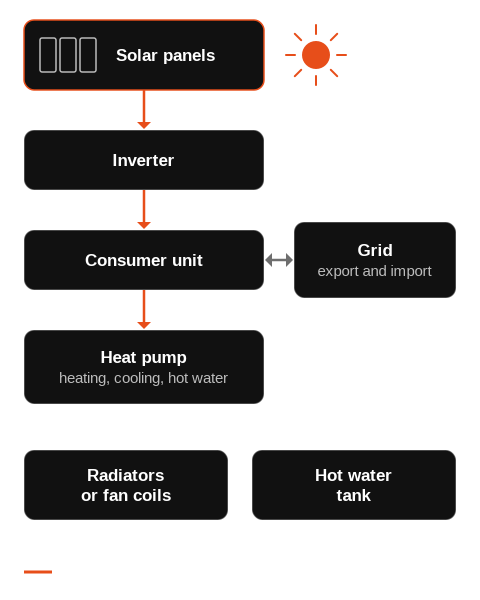
In winter the panels produce less and will not cover everything, but the heat pump can be programmed to heat the hot water tank during the sunny hours, and in summer the cooling demand coincides with peak production. If you fit panels and a heat pump together, size the panels with the heat pump’s new consumption in mind: we explain how in how many solar panels you need.
Run the numbers for your home
The configurator asks for the floor area you need to heat and how you heat it now, and gives you the price for your combination in writing, with no phone calls. The technical survey then checks the circuit, the radiators and the spot for the outdoor unit before anything is agreed.